Sisyphus
Hills, boulders, and meaningless work


“What do I have to complain of, if I’m going to do what I was born for—the things I was brought into the world to do?’”
-Marcus Aurelius, Meditations
Notable British comedy duo, Robert Webb and David Mitchell’s new sketch show, Mitchell and Webb Are Not Helping, has provided some fresh entertainment for those of us nostalgic for the simpler days of sketch show television (or wanting more of Tim Robinson’s unique brand of zany).
In a recent episode of the sketch series, Mitchell plays the part of a confused math teacher, baffled at the idea that the children he spends all year teaching are (somehow) replaced every summer with brand new kids for him to teach.
“The job is for me to carry on teaching children fractions until I’ve taught all the children in the world or I die, whichever happens first? How could you begin to pay me enough for such a feat of sisyphean futility?”
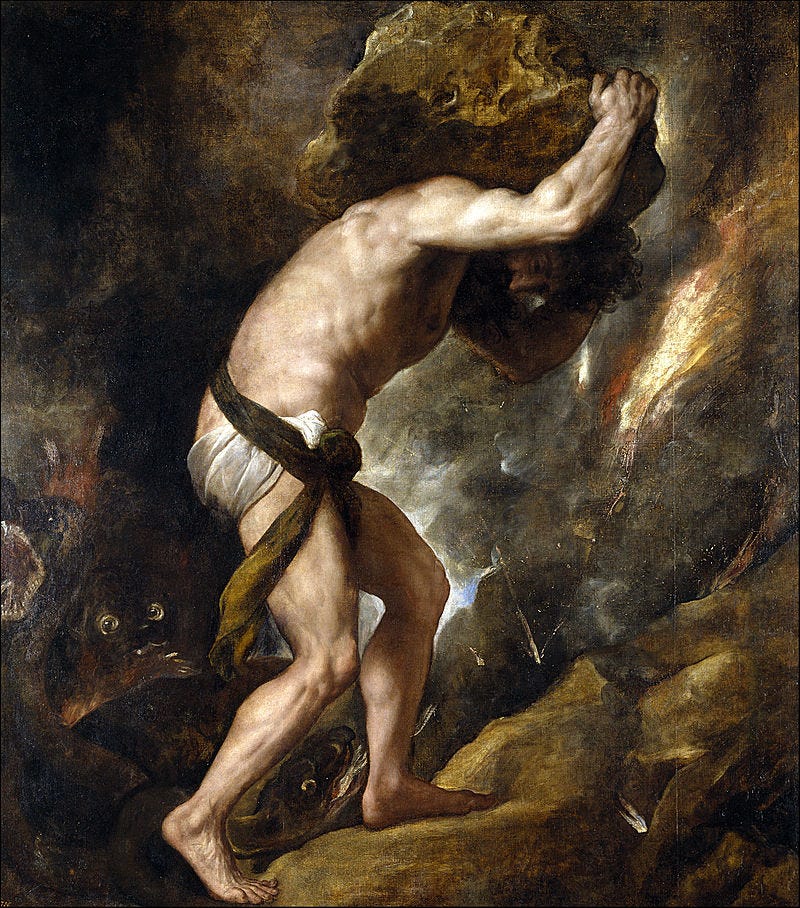
In Greek mythology, Sisyphus, king of Corinth, is condemned for trying to cheat death. His eternal punishment is to roll a colossal boulder up a steep hill, only to watch it roll back down each time he nears the summit. He must repeat this task forever.
In the modern imagination, “Sisyphean” has become shorthand for endless, futile struggle.
But this interpretation misses a key point.
What makes a task truly Sisyphean isn’t its repetition, but its meaninglessness. The essence of the punishment isn’t the repeated cycle of physical labor; it’s that the labor serves no one.
Like the classic “tree falling in an empty forest”, the effort is real, but without purpose or witness, what does it matter? The work is just wasted energy, a sound unheard.
Consider Mitchell’s teacher again. Every year he teaches “maths” to a fresh batch of children, seemingly starting at zero each fall. This looks Sisyphean on its face, except for the crucial difference that, unlike Sisyphus’s rock, the knowledge doesn’t roll back to the bottom of the hill; it stays with the students, who are left better for the effort.
The teacher’s work has a purpose.
Think of the software developer debugging code. The flow of bugs is endless, and fixing one just leads to another. The developer is never escaping the day-in, day-out experience of reading through lines of code. But each fix strengthens the product, improves the user’s experience, and contributes to a larger goal. The labor is cyclical, but the outcome is cumulative.
The mistake is to think a happy life is one without a boulder to push. Life is the labor of pushing the boulder. Today’s problems are replaced by tomorrow’s problems. This year’s goals give way to next year’s goals.
In this, we are all like Sisyphus; the cycle of effort is our shared condition. The crucial difference is that his task was futile. He was given a burden that served no one—not himself, and not the world around him.
Our freedom lies not in escaping the hill, but in choosing the right boulder. Pushing a meaningless one leads to burnout and cynicism. But pushing one that matters, one that serves a purpose we believe in, builds resilience and fortitude. By accepting that the labor is constant, we can stop wasting energy wishing it away and instead focus on finding the best application for our effort.
The goal isn’t to reach a final peak where the work stops; it’s to embrace the effort because we know the world is better for it.
Nothing we seek to accomplish will be done without pushing our individual boulders up our respective hills. Yes, we should find moments to stop, to rest, to prepare ourselves for the ascent. But we must never deceive ourselves into believing that the life of deeper meaning and purpose is found at the bottom of the hill.
We are constantly pursuing the summit. And if not for what we’ll find there, then for the person we become on our way.
Sisyphus’s boulder was a curse. Ours is a choice.
Good luck out there.
-Patrick