The Employees are Wrong

“The best feedback is what we don’t want to hear.” — George Raveling
Author’s note: I’m planning a sabbatical from the blog to work on a book related to these blogs. I’m planning to return to writing in early October.
Years ago, when my wife was teaching middle school English, she worked under a principal who provided an unforgettable experience in management behavior and psychology.
As part of a routine employee engagement survey, the school faculty answered a question about their trust in leadership. The results came back largely neutral to negative. Not damning, but definitely not a vote of confidence.
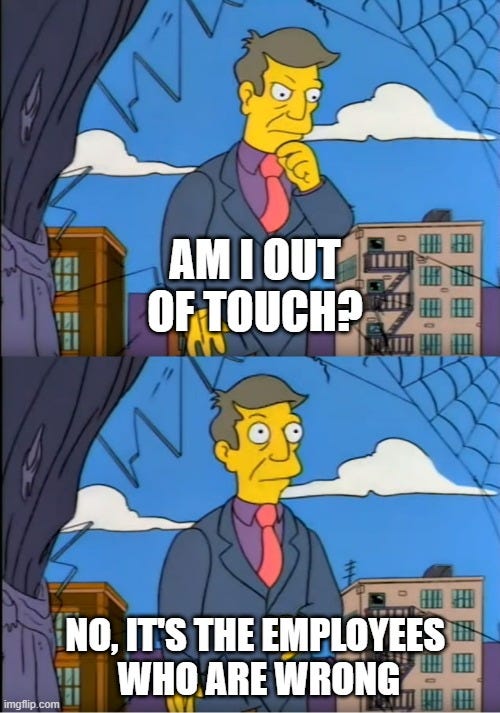
Most leaders in that position would have at least noted the poor result and offered some token explanation. Instead, this principal doubled down.
In a meeting to review the data, she offered her interpretation: that neutral or slightly negative responses were actually signs of support, because, in her words, “if they really disagreed with me, they would’ve rated me lower.”
In the principals mind, the results were positive because if you added the neutrals and the slightly negatives, she had a majority positive score.
It was the definition of defensiveness and self-deception. Rather than sit with the discomfort of feedback, she spun a version of reality where the absence of glowing praise somehow equated to endorsement.
It wasn’t leadership, it was damage control.
The problem all managers have is we share a trait fundamental to being human: avoiding any feedback that feels negative or ego challenging.
Faced with the potential for negative feedback we tend towards one of three options:
Going out of our way to avoid any feedback
Soliciting only positive feedback (or working hard to reframe any feedback as positive)
Labeling negative feedback as having come from malcontents and bad actors
Pick your poison.
What should we expect of workplace cultures that prominently feature an avoidance of honest feedback? How could we expect to build cultures of trust and collaboration if our behaviors demonstrate a we want the opposite?
If our stated goal as leaders and professionals is to have a positive impact on our cultures and our workplaces, then we have to also accept our responsibility in demonstrating a desire for the kinds of feedback that can help us achieve that.
Any employee who we’d take seriously in their positive feedback should have the same credibility when it comes to their negative feedback.
We cannot create a culture of growth without allowing for uncomfortable communication that occasionally hurts our feelings. Leadership requires us to show the ability to sit with conversations and interactions we don’t like rather than seeking to make sure we never experience these things at all.
The default setting for healthy management is curiosity, not control. Feedback we don’t like serves as an invitation to explore our own blind spots and things we may not have been paying attention to. Egos get in the way when we internalize feedback as personal failure rather than professional insight.
We have to ask ourselves: do our employees have something that they can teach us? Is their perspective meaningful to how we think about doing our job? The moment we feel triggered or undermined is often the exact moment where leadership is most needed.
Like an immune system, we need to be able to distinguish between harmful attacks and helpful signals. Overreacting to honest feedback by treating it as a “foreign substance” puts unnecessary stress on this system, destroying it from within.
Great cultures aren’t built by leaders who never feel challenged. They’re built by leaders who can feel challenged without retreating into defensiveness or blame. When we get triggered by feedback, that doesn’t mean the feedback is invalid. It means it touched something real. This is the moment to reflect, not react.
Too many managers confuse control with stability. But control is about silence. Stability is about strength. The strongest leaders you’ll meet are the ones who can hear the hard thing and still stay present. They don’t flinch. They don’t argue. They make space.
And if you’re not sure what to say in those moments, you might borrow this script:
“That’s hard to hear, but I appreciate you telling me. Let me sit with it and come back to you.”
This one sentence keeps the door open while giving you time to think. It shows you’re still listening, even if you’re not ready to respond. That’s the real work. Not the absence of reaction, but the presence of knowing a productive way forward.
The uncomfortable truth is this: the quality of your leadership is directly tied to your ability to regulate your emotional response in the moments where you most want to shut down.
Until we can hear the hard things—really hear them—we’re not building culture. We’re just protecting our ego.
Good luck out there.
-Patrick